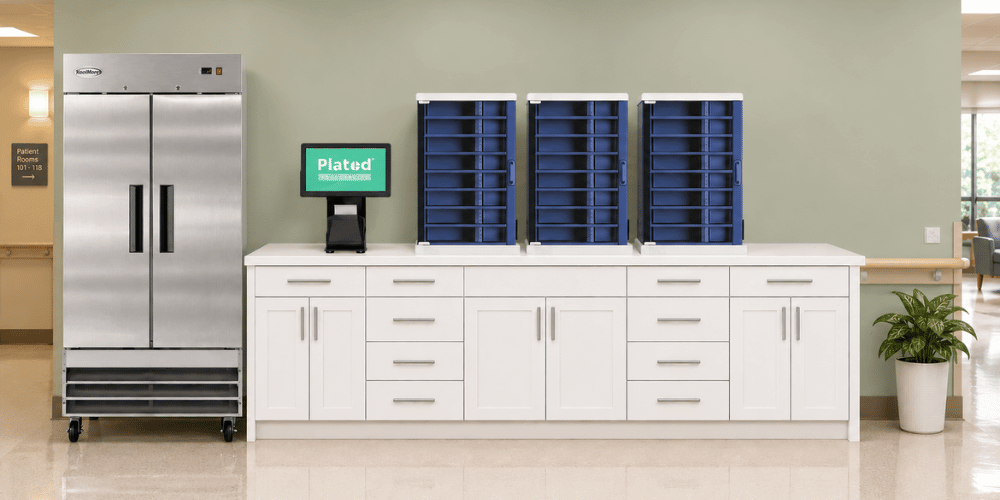
Many healthcare and community facilities need reliable community meal service but lack the space, budget, or staff for a full commercial kitchen. The good news: kitchenless foodservice models now make it possible to serve nutritious, high-quality meals without traditional cooking infrastructure. The challenge is choosing the right approach, because not all kitchenless models deliver the same dining experience.
What Is Kitchenless Community Meal Service?
Kitchenless meal service replaces on-site cooking with pre-prepared meals that arrive frozen, refrigerated, or shelf-stable and are heated at the point of service. Facilities may store meals in standard refrigerators or freezers and use microwaves or other heating equipment to bring them to safe serving temperatures.
This model is particularly relevant for skilled nursing facilities, behavioral health centers, IDD day programs, and hospitals navigating staffing shortages and rising labor costs. By removing the need for trained cooks, specialized ventilation, and large prep areas, kitchenless programs allow your team to focus on care rather than food production.
How Most Kitchenless Providers Heat Meals
Several kitchenless foodservice providers exist in the healthcare space. Most rely on one of two approaches: microwave-based heating or oven-based warming that often still requires labor and plating.
With microwave-based models, individual meals are heated one at a time. Microwaves can create uneven hot and cold spots, and the rapid, high-energy process often changes food texture, leaving proteins tough and vegetables overcooked. For a facility serving dozens of residents at a scheduled mealtime, heating meals individually also creates a significant time bottleneck.
Because oven-based models often arrive refrigerated rather than frozen, their shelf life is shorter. Manual oven heating is required, which can yield more consistent food quality compared to microwaves. However, this added handling increases labor demands, multiplies process steps, and heightens the potential for food safety risk.
What Makes a Multi-Unit Rethermalization System Different
Plated Foodservice takes a fundamentally different approach with its patent-pending rethermalization appliances. Instead of microwaving one meal at a time or warming large trays of food in an oven, your team loads up to eight individually plated, vacuum-sealed meals directly into a countertop unit.
Each unit uses low-slow conduction heating to bring meals to a consistent internal temperature (typically around 165°F) without the uneven results that microwaves produce. Meals arrive fully cooked and plated, so there is no additional preparation and no manual plating required. The meal management software guides staff through every step on a touchscreen portal, from selecting the right meal to placing it in the correct slot.
After rethermalization, meals hold at safe serving temperature for up to two hours, in accordance with USDA food safety guidelines, giving your team flexibility during service without compromising quality or compliance.
Why the Heating Method Matters for Your Facility
The difference between heating methods shows up at the patient tray. Microwave heating often produces what foodservice professionals describe as "rubberized" proteins and unevenly warmed sides. Oven-based approaches can deliver better texture, but the added labor of unpacking, loading the oven, and plating introduces operational complexity that many understaffed facilities cannot absorb.
Plated Foodservice’s multi-unit rethermalization system uses low and slow conduction heating and distributes warmth gradually and evenly. This process safeguards the flavor, moisture, and original texture of every meal, offering a key advantage over other kitchenless options in healthcare. As a result, residents enjoy meals that taste freshly made, while caregivers can dedicate less energy to meal coordination and more time to resident care.
Getting Started with a Kitchenless Meal Program
Transitioning to a kitchenless model starts with assessing your facility's needs: the number of residents or patients you serve, your dietary requirements (therapeutic diets, texture modifications, carbohydrate-controlled plans), and your available staff and space.
With Plated Foodservice, setup requires only a countertop, a freezer, standard wall outlets, and an internet connection. Meals are delivered frozen on a regular schedule, and your team manages everything through the integrated platform. Because the system scales with census, you prepare only what you need, reducing food waste and keeping budgets predictable.
Choosing the Right Kitchenless Partner for Community Meal Service
Kitchenless foodservice has opened up real possibilities for facilities that once had limited options. When evaluating providers, the heating method is where the most meaningful differences emerge. A microwave-only model may check the "no kitchen needed" box, but it comes with trade-offs in food quality and operational efficiency. An oven-based approach reduces some of those quality concerns while adding labor back into the equation.
Plated Foodservice's multi-unit rethermalization system was built to address both challenges at once: consistent food quality through conduction heating and minimal staff involvement through a fully plated, software-guided process. For facilities looking to deliver dignified, nutritious meals without a commercial kitchen, that combination matters.
Reach out to the Plated Foodservice team to learn how the system works in your specific care setting.